
MOVEMENT PATTERN 06
G.R.O.U.N.D.™
A functional squat built from the ground up.
PURPOSE
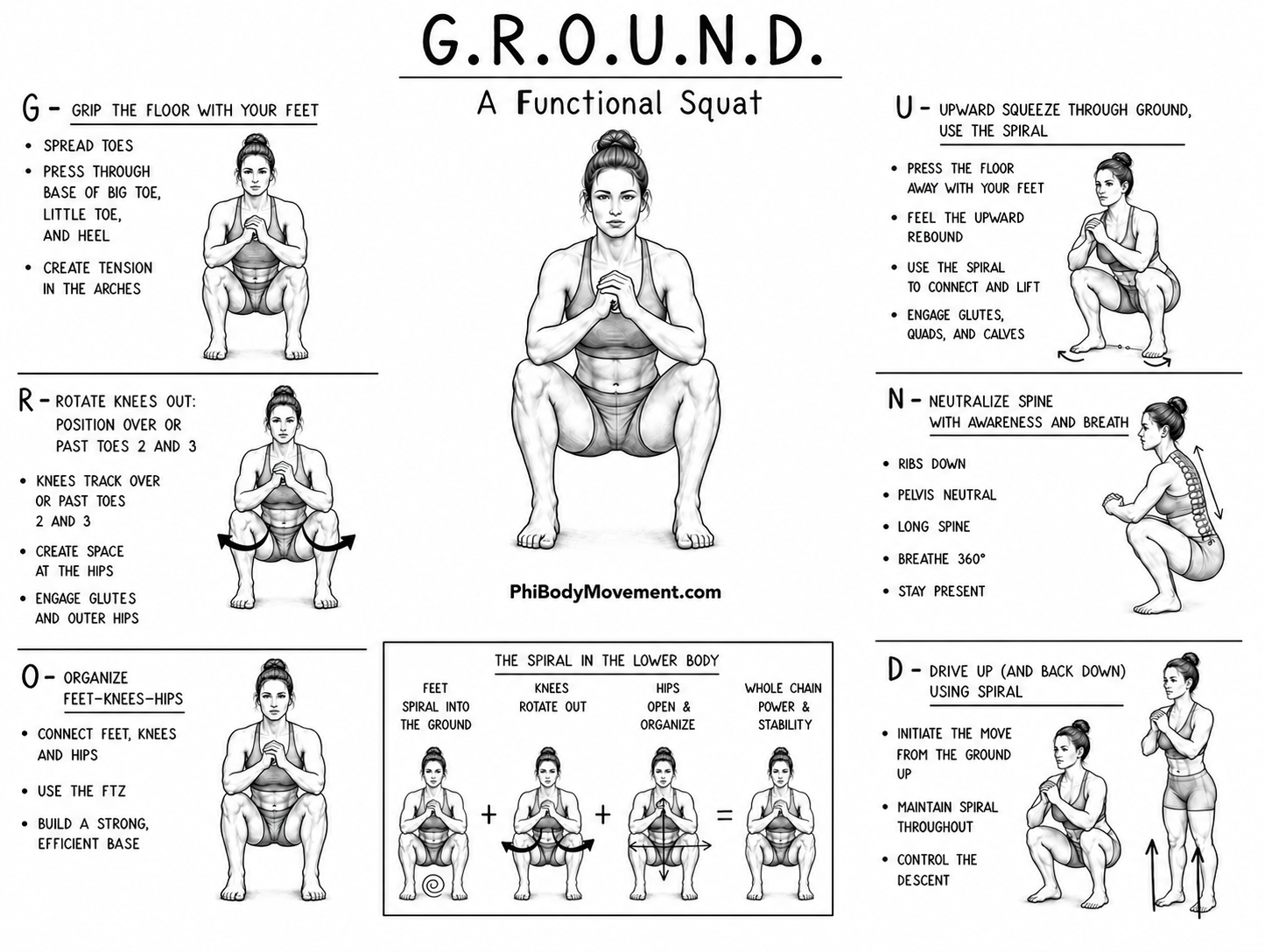
Toddlers do it perfectly. Cultures without chairs or sofas did it all day. For most modern adults, it has become a source of knee pain, back pain, and frustration. G.R.O.U.N.D.™ is the rebuild. It uses focused foot contact, leg alignment, hip control, and coordinated, intentional sequencing to turn the squat into a connected, full-body movement rather than a heavy joint and imbalanced muscle driven one.
G.R.O.U.N.D. set up is in the squat position, then moves you to standing.
THE SEQUENCE
Six letters.
A safer, stronger squat.
G — GRIP THE
Activate the Foot Torque Zone
Spread the toes. Feel the tripod base — big toe, Focal Point, heel. Activate. This is the lock that stabilizes everything above it. Without this, the knees and low back take the load alone. Stay anchored.
R — ROTATE THE KNEES
Track the knees out over the toes
Allow the knees to track in line with or just beyond the 2nd and 3rd toes — this is approximately a 22.5 degree angle. The spiral begins here, through the floor. Allow the rotation to emerge from the anchored FTZ through the foot and ankles.
O — ORGANIZE THE
Think of hips as a ball-joint pivot
Feel your feet anchored, torque starts to build from FTZ through the legs into the hip. Connect feet to glutes through the spiral. Feel the hip joints as the pivot point for the ascent.
U — UPWARD
Press into the floor, build torque
Before you ascend (stand up), there is an upward coiling force building at the feet with the ground. In G.R.O.U.N.D. you are not just pushing in a linear fashion— you are actively engaging the spiral in both legs. This intentional pressing creates control and strength, throughout the full range of motion. This building force potential starts at the feet and moves upward.
N — NEUTRAL
Maintain natural spinal curves
Keep the natural lumbar curve throughout — especially at the bottom. The low back should feel supported, not rounded or compressed. Breath helps maintain this — use S.T.A.C.K.™ awareness here.
D — DRIVE THROUGH THE
Use the full spiral torque on the way up
Now, press through the full tripod of the foot. Feel the glutes fire. Use the rotational tension built through the G-R-O-U-N-D set up to drive an efficient ascent. The spiral releases through the legs as the hips move forward.
SIMPLE CUE
Stay connected to the ground.
Focus control from feet to hip.
Drive the spiral upward.
THE G.R.O.U.N.D PRINCIPLE
The ground does not
create movement.
↓
It provides resistance
When the foot meets the ground with organized load — through the FTZ — the ground resists through static friction. This creates a stable, non-slipping interface that the body can organize against.
↑
The body organizes against it
Movement comes from how the body uses that resistance. The spiral through the foot and leg is not pushed into the ground — it emerges from organized contact with it. This is what makes G.R.O.U.N.D.™ efficient.
◎
Columns carry force
The foot is organized into pathways — columns that carry force — and arches that adapt and redistribute it. The lateral and medial columns work together through the FTZ to share load across the entire foot.
∿
Arches manage force
The transverse and longitudinal arches respond to load rather than collapse under it. This is the foot's spring mechanism — activated by organized FTZ contact, not by forcing or bracing.
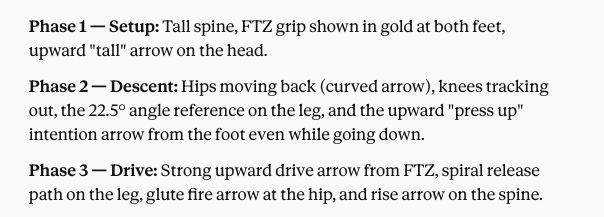
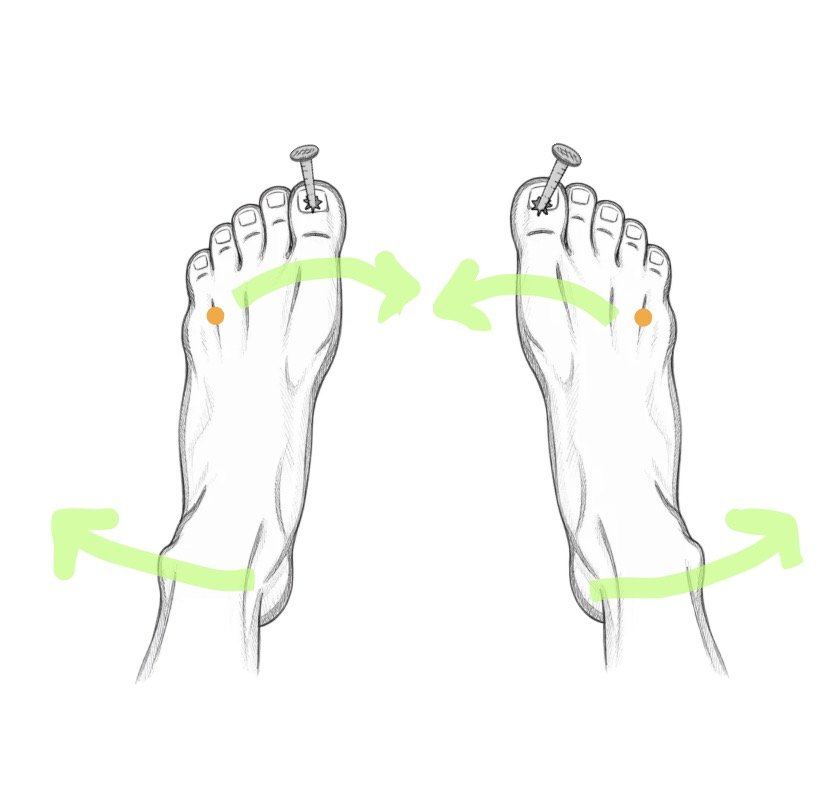
During the initial descent before your knees approximate 90 degrees, think about twisting (coiling) forces being generated as in the image above. The Big Toe and Heels stay anchored! This portion of a G.R.O.U.N.D. functional squat is H.E.L.I.X., that then proceeds to…
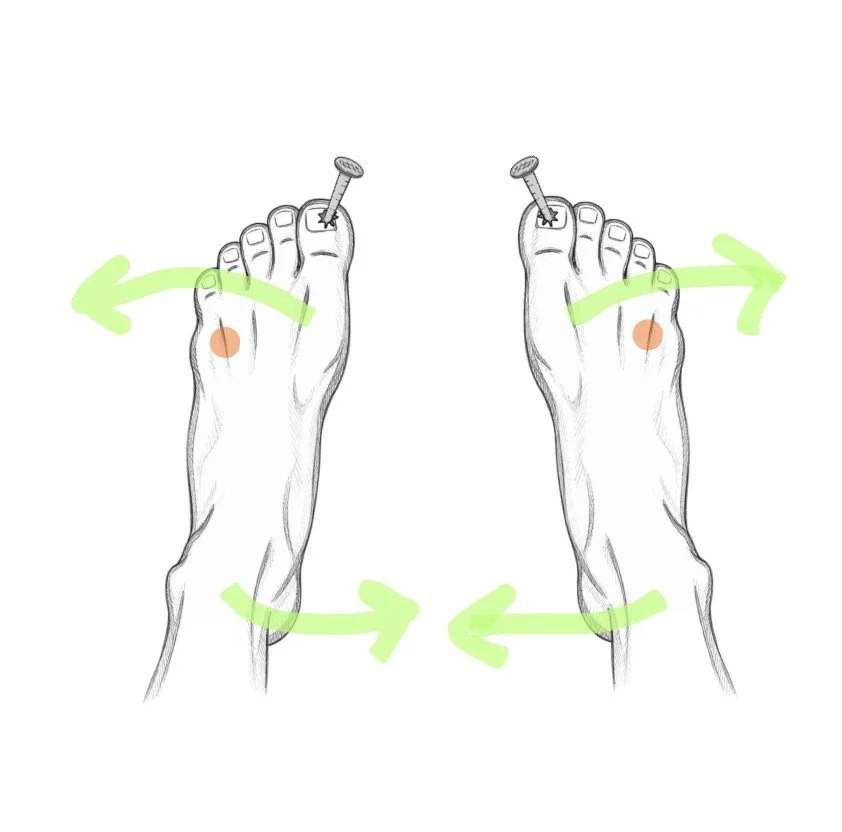
…A full G.R.O.U.N.D. Squat. After you bend/descend your knees approximately beyond 90 degrees, now think about twisting (coiling) forces being generated in the opposite direction, as in the image above. The Big Toe and Heels stay anchored! This portion of a squat is also H.E.L.I.X..
TIPS:
GET DOWN
Think about your knees moving out, tracking over your smaller toes (2-5) while bending into a squat. This is a sign that your hip joints are opening up and allowing more space for you to get into a squat position.
While at the end of your deep squat (at your ability and comfort!), try and rest in a tripod foot position. Become aware of your body and how it feels, breathe.
Practice “pulsing’. Going from a rested tripod position into twisting and squeezing from the ground up into your hip joints (As in second image). This activates your Adductor muscles - the second largest muscles in the body, and a primary mover to a standing position (hip extension)!
Practice S.T.A.C.K. breathing. Become aware of how this feels.
GET UP
To begin the act of standing back up, think about the forefoot aspect of your feet “spreading the floor”. Keep big toe/fp anchored. The heels are squeezing inward towards each other, but they stay rooted as well. The torque force would then be 80% outward from the forefoot, and 20% inward at the heels. This we feel creates maximum efficiency, safety, and strength!
For maximum deep core integration, do a S.T.A.C.K. breath on exhalation while standing.
t
WHY IT MATTERS
Most squat problems have
the same root cause.
UNORGANIZED SQUAT
Joints take the load
Ankles, feet, and hips not doing their jobs
Knees absorb raw compressive forces (typically medially)
Low back rounds at the bottom
Movement feels unstable and effortful
Risk of injury increases over time
G.R.O.U.N.D.™ SQUAT
The system shares load
Feet grip and the chain activates from below
Knees track safely along their functional design
Lumbar discs loaded axially — as designed
Movement feels stable, wide, and rooted
Quads, hamstrings, and glutes share the work
PUTTING IT TOGETHER - FROM THE GROUND UP, THEN DOWN
WHAT TO FEEL
The squat should feel
like a spring, not a drop.
ON THE WAY DOWN
Controlled and rooted
Stable, wide, and grounded through the feet. The descent is a lowering — not a drop — with quads, hamstrings, and glutes sharing the work evenly throughout.
AT THE BOTTOM
Spring, not collapse
There should be a sense of spring at the bottom — an organized tension ready to release. If there is collapse or discomfort, return to G — re-grip the feet — and start again.
ON THE WAY UP
The spiral releases
Drive through the heels. Feel the glutes fire. The spiral that built during the descent now releases through the legs as the hips extend and the body rises.
THROUGHOUT
Even, connected, repeatable
The movement should feel the same rep after rep. If something feels off — tension, instability, or strain — return to the ground. The foundation always comes first.
Φ BODY INTEGRATION
G.R.O.U.N.D.™ within
the full system.
The feet (FP/FTZ) provide the base
The torso stays connected through the sequence (S.T.A.C.K.)
The body organizes upward from that base (S.T.A.N.D.)
The hinge begins at the hips (H.E.L.I.X.)
The legs guide alignment and load (G.R.O.U.N.D.)
This creates a ground-to-body connection throughout the squat.
NEXT CONCEPT
Ready for
S.P.I.R.A.L.S.™?
S.P.I.R.A.L.S.™ brings basic, and sound, rotational principles to the shoulder — restoring mobility and coordination from hand to torso.