
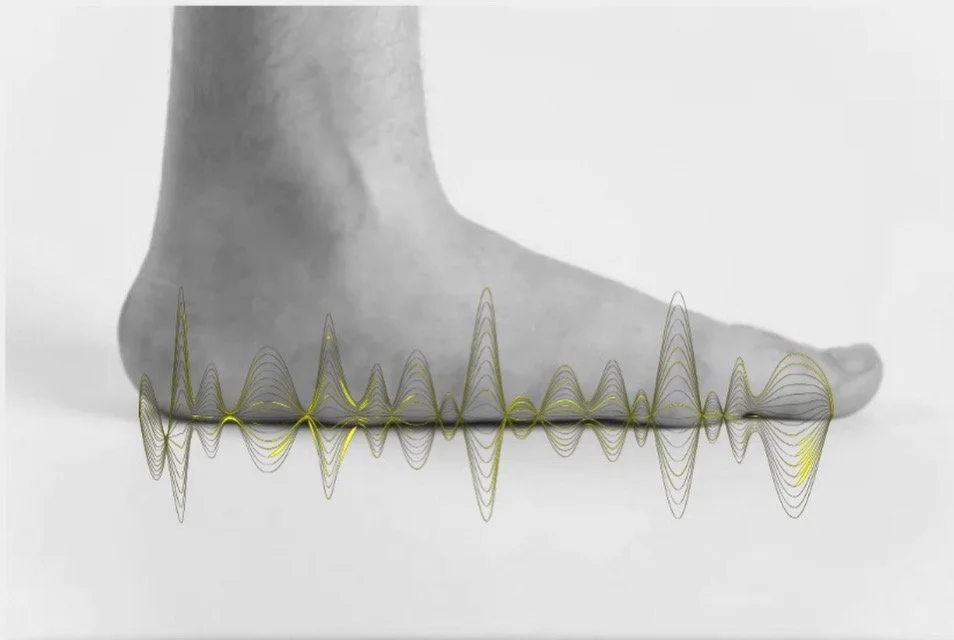
Why does foot loading matter anyway?
Foot loading signifies how your foot integrates your body weight when you start to apply pressure while beginning to stand up onto your foot (ground force/weight bearing)
Think about how many times you are actually doing this each day, like walking. This might even include times you stand up from sitting too, like from your work desk or bathroom.
Poor foot loading changes what happens at the foot. It changes the mechanical information entering the body—potentially altering fascial strain, fluid movement, sensory feedback, and how forces are organized upstream.
Fascia is living tissue responding continuously to its environment. Movement changes its mechanical environment. Poor continuous loading into the foot may cause structural changes leading to dysfunction (and not just at the foot!)
BETTER FASCIAL FUNCTION, BETTER MOVEMENT
Φ Body brings awareness to where force enters the body because the first area of contact helps shape what happens upstream. By intentionally changing load entry, we change the mechanical information entering the connective tissue system—altering tension, compression, shear, fluid movement, sensory input, and potentially the biological signals that influence tissue adaptation.

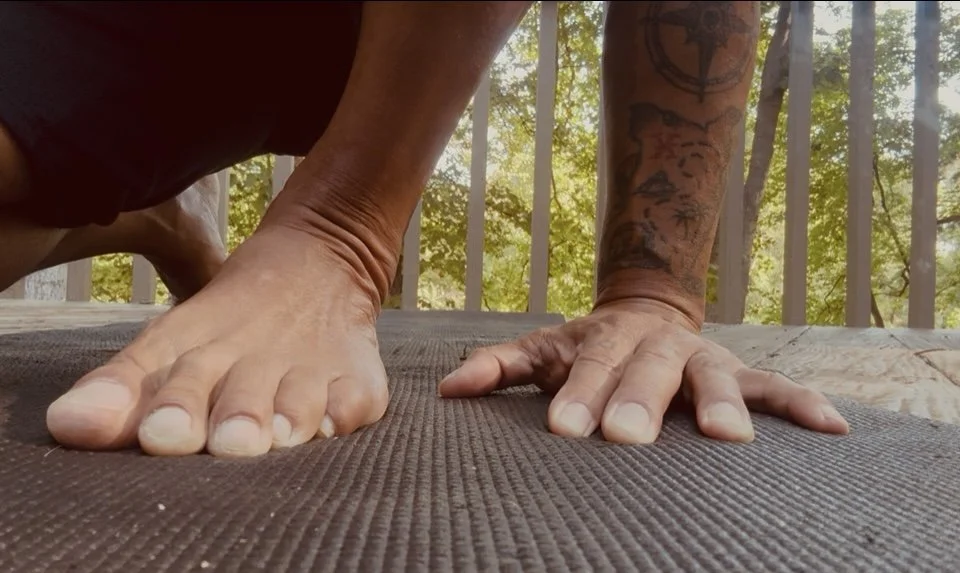
Which pic shows the most stable loading position?
For those that want to know more…
Poor or inefficient foot loading could potentially:
Alter force entry — Ground-reaction forces enter through a different location, direction, or timing than intended for the task.
Change the strain pattern in fascia — Because connective tissues respond to tension, compression and shear, altered loading changes where, when and how much tissues deform.
Concentrate stress — Instead of distributing load across multiple structures, certain joints, tendons, fascial regions, or muscles may repeatedly receive disproportionate loading.
Reduce useful tissue deformation elsewhere — Some tissues may be overloaded while others receive relatively little mechanical stimulus.
Alter mechanotransduction — Fibroblasts and other cells respond to their mechanical environment. Change the mechanical signal and you potentially change the cellular signal.
Alter collagen electromechanical effects — Because collagen demonstrates piezoelectric/electromechanical behavior, changing collagen deformation necessarily changes the conditions under which these electrical phenomena occur. This does not establish that one foot-loading strategy generates a superior electrical effect.
Alter interstitial-fluid dynamics — Compression and release during movement contribute to local fluid redistribution. Different loading patterns can therefore change pressure gradients and fluid movement within tissues.
Change sensory information — The plantar foot is densely sensory. Changing pressure and shear at the ground changes the afferent information available to the nervous system.
Change upstream motor organization — Different sensory and mechanical inputs from the foot can influence ankle, knee, hip and whole-body movement strategies.
Reinforce the altered pattern through repetition — Thousands of steps provide repeated mechanical and sensory exposure. Over time, tissues and motor behavior adapt to what they repeatedly experience.
Potentially contribute to maladaptation — If loading repeatedly exceeds a tissue's capacity or is poorly distributed, remodeling may not necessarily be beneficial.